
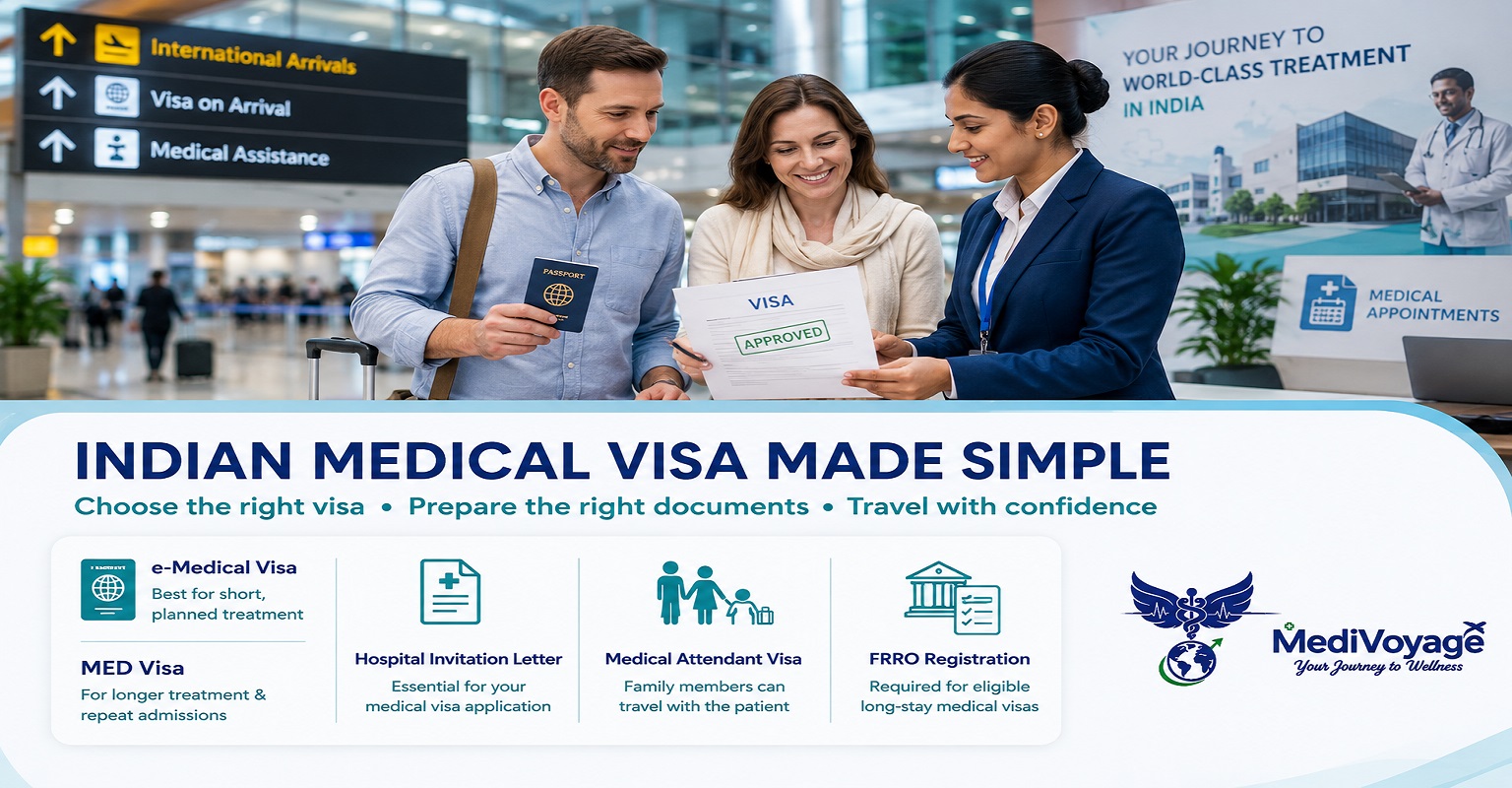
Indian Medical Visa for International Patients: What You Need in 2026
Most families we speak to have already made the hard decision. They know which surgery they need. They have found the hospital. Then the whole plan stalls at a government website, because nobody told them which box to tick.
That is the real bottleneck. Treatment in India moves fast once you land. The Indian medical visa is what decides whether you land at all, and whether you land on time.
This guide covers what actually matters: the two visa types, who qualifies for which, the paperwork the embassy checks, the rules for family members travelling with you, and what happens after you clear immigration.
What an Indian medical visa is
It is a visa issued only for treatment. Not tourism, not business, not visiting relatives. You apply on the basis of a specific medical problem, at a specific hospital in India, on a roughly known date.
The Indian government treats this category more generously than a tourist visa. Longer stay, more entries, easier extension. In exchange, it wants proof: your reports, your diagnosis, and a letter from the hospital that has agreed to treat you.
Some governments make you prove you will leave. India mostly wants to know you are genuinely sick and genuinely expected somewhere.
The two options: e-Medical Visa or regular MED visa
People assume there is one medical visa. There are two, and picking wrong costs time.
The e-Medical Visa is the online one. You apply at indianvisaonline.gov.in, upload a passport scan and a photo, attach your hospital letter, pay the fee, and wait a few days for an email. No embassy visit. No appointment queue. It is meant for short, defined treatment: a surgery, a course of chemotherapy, a transplant workup.
It comes with limits. It is a short-validity, multiple-entry visa, and you must enter through one of the designated international airports or seaports. It also cannot be used by everyone. Holders of Pakistani passports, and people of Pakistani origin, are not eligible and must apply through a mission.
The regular MED visa is the sticker visa from an Indian embassy or High Commission. You book an appointment, submit the physical file, and hand over your passport. Slower to get, but stronger once you have it. It is granted for up to a year, or for the expected length of treatment, whichever is shorter. Six months with triple entry is a common default.
Here is the short version.
One caution. The validity terms on the e-Visa have been revised more than once, and the official portal is the only place that is always current. Check it the same week you apply, not three months earlier. Do not build your flight booking around a number you read on a blog, including this one.
If your treatment plan runs past six months, or involves several admissions across a year, skip the e-Visa. Apply at the mission.
Bringing family: the medical attendant visa
You are not expected to travel alone. India issues a separate medical attendant visa for the people coming with you.
The general rule for most nationalities is two attendants at a time. Bangladesh nationals are allowed three. Pakistan nationals are allowed one. If you are applying online, only two e-Medical Attendant Visas will be issued against one e-Medical Visa.
Attendants are usually a spouse, parent, adult child or sibling. Their visa is tied to yours, so it is issued for the same period and cancelled if your medical visa is refused. They apply separately, but their application should reference your passport number and your case.
A small thing that helps: keep the relationship obvious. A marriage certificate or a birth certificate clears up questions that a shared surname does not.
Documents you need before you apply
Nothing here is unusual. The applications that get delayed are the ones missing one item, and the delay is almost never explained.
-
Passport valid at least six months beyond your travel date, with two blank pages
-
Recent passport-size photograph on a plain white background
-
Medical reports and a diagnosis summary from your doctor at home
-
Invitation letter from the Indian hospital on official letterhead
-
Proof you can pay: bank statements, an employer letter, or a sponsor letter
-
Return or onward ticket, or a travel plan
-
Address in India, usually the hospital or the guest house near it
The hospital letter is the document everything else rests on. It must name you and your passport number, state the diagnosis and the planned treatment, give an admission date or a tentative one, and carry the hospital's registration details and a signature.
A generic letter saying "the patient may visit for consultation" is not enough. Visa officers see hundreds of those.
If you have not fixed on a hospital yet, our guide to the best hospitals in India for international patients covers how to shortlist properly before you request the letter.
How the application actually runs
Step 1. Send your reports to the Indian hospital, or to a coordinator who will route them. You want a written medical opinion and a cost estimate, not a phone call. Cost guides for common procedures, such as heart bypass surgery and knee replacement, help you sense-check the figure you get back.
Step 2. Ask for the visa invitation letter once the hospital confirms it can treat you. Check the spelling of your name against your passport, letter by letter. Mismatched names are the single most common reason files come back.
Step 3. Apply. Online for the e-Visa, minimum four days before travel and up to 120 days ahead. In person for the MED visa, ideally a month out.
Step 4. Pay the fee. It varies by nationality and is published on the portal. Fees for African and South Asian passport holders are often lower than the headline figure, so check your own country's row rather than assuming.
Step 5. Print everything. The approval email, the hospital letter, your reports. Immigration officers ask.
After you land: FRRO registration
This one catches people out, and the penalty is real.
If your visa is valid for more than 180 days, you must register with the Foreigners Regional Registration Office within 14 days of arrival. Registration happens online at indianfrro.gov.in, followed by a document check.
If your visa is 180 days or less, you do not register. Most e-Medical Visa holders fall here and can ignore the whole process.
Pakistan nationals follow a stricter timeline regardless of visa length: seven days for the patient, 24 hours for attendants.
Registration needs your passport, visa copy, four photographs, a hospital certificate confirming you are under treatment, and proof of your address in India. Hospital international patient departments handle this routinely. Ask them on day one rather than day thirteen.
Extending your stay
Recovery does not always follow the plan. Grafts fail to take. A transplant patient develops a complication. Chemotherapy gets pushed by two weeks.
Medical visas can be extended by the FRRO for up to one more year, on the strength of a certificate from the treating hospital explaining why you need to stay. Extensions beyond that go to the Ministry of Home Affairs.
Even the e-Medical Visa can be extended in genuine cases, decided one file at a time by the FRRO. Start the paperwork before your visa expires. Overstaying, even by a week, creates a fine and a record that will follow you into your next application.
Five reasons applications get rejected
-
Name mismatch. The passport says one thing, the hospital letter says another.
-
Vague hospital letter. No diagnosis, no dates, no registration number.
-
Wrong visa category. People apply on a tourist visa and hope to convert. You cannot.
-
Thin financial proof. No indication of who is paying for a 15,000 dollar procedure.
-
Unlisted or unrecognised hospital. The facility must be a recognised one.
Every one of these is fixable in an afternoon before you submit. None of them is fixable after a refusal, which stays on your record and makes the second attempt harder.
Where MediVoyage fits
We handle the part between your reports and your boarding pass, and we do not charge patients for it.
That means routing your files to the right specialist, getting you a written second opinion and a cost estimate, obtaining the visa invitation letter from the hospital, checking your document set before you submit, arranging airport pickup, sorting accommodation for your attendants near the hospital, and organising an interpreter if you need one.
We also stay involved after discharge, because follow-up scans and reports still have to reach your doctor back home.
You can tell us about your case here, or read our complete guide to medical tourism in India if you are still deciding.
Frequently asked questions
How long does an Indian medical visa take? The e-Medical Visa is usually approved in three to five working days, sometimes faster. An embassy MED visa takes one to three weeks depending on the mission and the season. Apply at least three weeks before your planned admission so a query does not cost you the surgery date.
Can I convert a tourist visa into a medical visa after arriving? No. Conversion from a tourist visa is not permitted, and hospitals will not admit you for a major procedure on one. If you are already in India on a tourist visa, you will need to travel home and reapply in the correct category.
Do I need a medical visa for a second opinion consultation only? For a consultation with no admission, some patients travel on a tourist visa. The moment treatment is planned, you need the medical category. Since a second opinion can be done remotely from your reports, most patients get the opinion first and travel once with the right visa.
How much does the Indian medical visa cost? The government fee depends on your nationality and is published on the official portal. Expect a modest amount for the e-Medical Visa, with an additional bank charge. Attendant visas are charged separately per person.
Is the medical attendant visa issued automatically to my family? No. Each attendant applies on their own, referencing your case. Approval is not guaranteed, and the number of attendants is capped by your nationality.
What if my treatment finishes early? You can leave whenever you are medically cleared. There is no penalty for using less of your visa than you were granted.
Which hospitals can issue the invitation letter? Any recognised hospital in India registered to treat international patients. Most large private hospitals have an international patient department that produces these letters daily.
Can children travel on a medical visa? Yes. Paediatric patients are issued a medical visa in their own name, with parents applying as attendants.
Before you book anything
Get the medical opinion first, then the invitation letter, then the visa, then the flight. Families who book flights early, hoping the visa will catch up, are the ones who end up paying to reschedule.
The Indian medical visa is not a difficult document. It is a specific one. Match the visa type to the length of your treatment, keep the names identical across every page, and make sure the hospital letter says something concrete.
If you would like us to check your file before you submit, send it across. It takes us an hour and it has saved patients several weeks.
Sources for the rules cited above: Bureau of Immigration, Government of India and the official Indian e-Visa portal. Visa rules change. Confirm on the government portal before you travel.